Paradata
This document contains paradata for they’re counting on you.. In it, I hope to summarize the processes that went into the creation of the game over the course of 2-3 months.
Initially came the planning phase. This being a public history project, there were some criteria it had to meet: first, it had to involve the city of Ottawa. Second, it need to incorporate some sort of physicality. As evident in my first Devlog post, I hadn’t even considered the possibility of researching the Shiners at first - mostly because I didn’t know they had even existed. I stumbled onto them when researching Ottawa’s homicide history, which was a concept I had already started researching in earnest as a possible avenue for my project. The shift seemed natural - I wanted to avoid causing harm to any families of homicide victims, and I had been struggling to discover a means to do so without neutering my project. The Shiners presented something of a blank slate, but they were also a tantalizingly interesting topic for me. Ottawa is often perceived as a ‘boring’ city, for better or worse, and the idea that the town was once ruled by a Mad Max-eqsue gang of rampaging gangsters certainly challenges that perception.
At first, I’d planned to make an interactive map, but I soon discovered I was treading too harshly on the toes of my predececssors - Nathalie Picard had done something similar with her project, Ottawa’s First Chinatown, and lacking direction on my own I had begun to take her idea and run with it. I eventually reconsidered. I have a passion for games and creative writing, and I wanted to put those passions to use. Enter Twine, a tool that allows the easy creation of interactive stories. I had some experience with Twine, so using it for my project seemed a natural choice - and it avoided the risks of diving into an application wholly unfamiliar to me. I used Sugarcube, which is a Twine story format that I found suited my needs better than Harlowe. Harlowe, from what I’ve seen, seems to be better for hyperlinked, choose-your-own adventure type stories. Sugarcube is a bit more complex, but allowed me to more readily implement gameplay elements, such as the sidebar in which I could use to list player stats.
I settled on a cyclical game. Essentially, it runs on a loop - using Corktown as a ‘hub’ where the player can work, pray, visit the store, or sleep. The challenge of the game lies in keeping yourself and your family alive despite your mediocre pay. Though I’d initially planned for a ‘family’ stat, I eventually settled on ‘compassion’ instead, since that more reflected the game’s central themes on how desperation can lead naturally to violence. Furthermore, some of the time certain choices are locked out by certain stats - for example, if your compassion is extremely low you won’t even get the option to refuse a profitable job that requires you to murder someone. This means that a lot of the player’s choices are determined by their previous choices, which means events can snowball in a good or bad way. This is intentional.
The actual design of the game would probably have been exceedingly simple for a skilled programmer. I am not a skilled programmer. I did manage to find some shortcuts which kept the final size of the game a manageable size, and thanks to Twine’s GUI you can see the rough size of the finished product here:
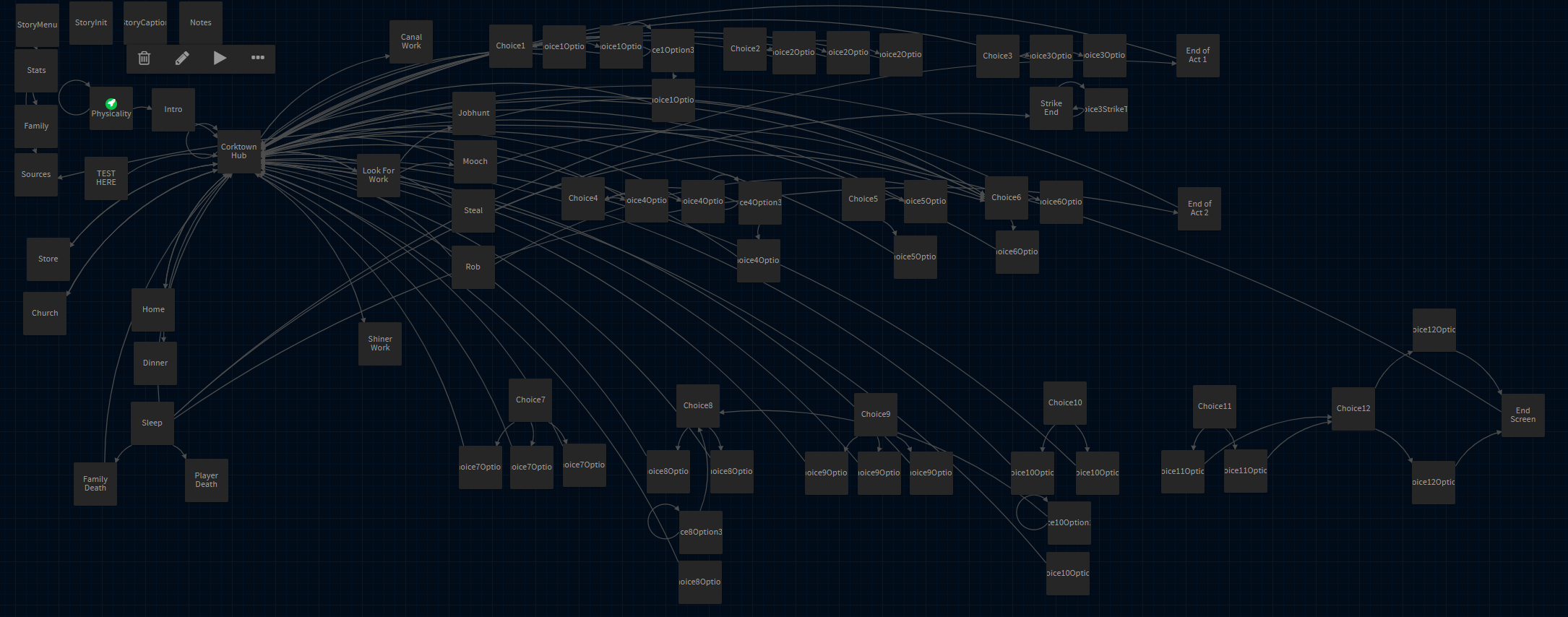
The documents towards the left of the window are often repeatable screens that the player will return to over and over, whilst the pages on the right, starting with ‘Choice’, are all the one-time choice events that the player will encounter as they progress on the game. The choices usually don’t have much code as the repeatable pages. I also added a few menus to the left of the screen, always present in Sugarcube, which detail in intentionally vague detail the player’s wealth, health, social standing, compassion, and the health of their family members. There’s also a ‘sources’ menu, always accessible, that provides the reader the option for further reading on the game’s setting.
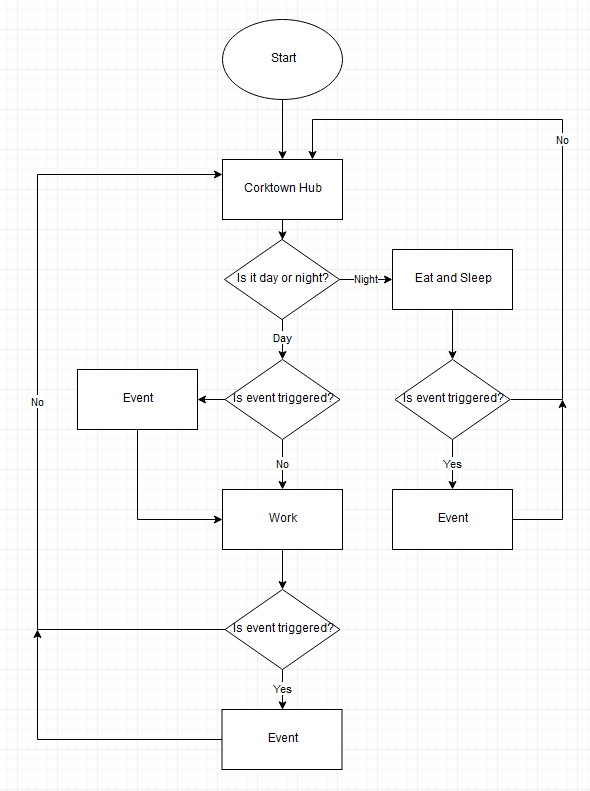
Ultimately, the goal of the game is to survive until Week 31. Doing so will present you one final choice and end the game. You will then be scored on how well you performed, based on how many of your family members survived, your status, and your compassion. I use the term scoring lightly - I figured a numerical representation of how well you did would cheapen the message, somewhat, so I essentially just let the player know the situation they ended in and let them draw their own conclusions as to how well they did. There is no reward or punishment for doing well or failing - the game is difficult, and the game is less a test of whether the player can survive and more a question of what they would do to survive.
This was my first Public History project, and much time was spent on research. I didn’t want to get things wrong. I hope my efforts bore fruit, and this game might engage players enough that the education it provides sticks. Western society is currently preoccupied with the nature and vectors of oppression, and it is my hope that this simple little game can present insight into an oppressed people’s historical struggles - not by valorizing or villanizing them, but by letting the players empathize with them.